Tuesday, October 28, 2014

No place to misbehave


Wilson "takes stock" of Rothenburg.

ROTHENBURG-- This is a town that knows how to deal with miscreants. Wilson, for example (pictured above), found out about the humiliation that awaits those who flout custom here. But I'm getting ahead of myself. For now, here's the official buzz about this amazing walled city just a short drive from Nuremberg:
"A medieval castle originally stood on the site of the baroque fortress: a Hilpold von Rothenburg was mentioned for the first time in 1254. Rothenburg was later owned by the burgraves of Nuremberg, followed by Emperor Karl IV, who as King of Bohemia thus acquired a new outpost. In 1401 King Ruprecht took the castle from King Wenceslas <Yes! King Wenceslas was more than someone's figment of imagination in a Christmas Carol> in Bohemia. During the Thirty Years' War, the castle was occupied by Bavarian troops, posing a considerable threat to the free Protestant city of Nuremberg. In the Spanish War of Succession, the now heavily fortified castle was taken in 1703 by the imperial troops and completely destroyed. After the peace treaty of 1714, Elector Max Emanuel rebuilt it as an even more powerful fortress, which proved its worth ... (source: http://www.schloesser.bayern.de/englisch/palace/objects/nbg_roth.htm)"
 Rothenburg is a must-see walled city of narrow streets and buildings clustered together like sardines. Visitors can walk the walls, gaining an idea of what archers did to keep the enemy at bay and the folk inside safe. And you can also get a taste of what awaits you if you misbehave.

From the highway approach visitors can see cannons poised at gunports.

A view of the protective wall and a watch tower from inside the city.

A similar view of the walkway that affords views of both the exterior and interior of the city.

To the left are ports from which archers can defend the city.

Why buy a brick to support the wall when you can have your name cast in concrete?

From the balcony, a view of the rooftops, one of which appears to be looking back, with three eyes.

Stacked roof tiles await installation.

Rothenburg gives the concept of "setback" an entirely new perspective.

In a city like Rothenburg, people have an opportunity to meet their neighbors.

This square was more open than much of the town.

One of the entries into the city.

A public fountain, at least at one time.

Incentives to behave

The folks at Rothenburg believed in punishment for misbehavior. There were offenses great and small. Even so much as touching the finger of a free woman might cost the offender a pfennig or two. Touch her wrist, and the fine gets heavier; her arm, heavier. Her breast -- now you're talking real money. The documents at the museum for punishment and torture made no mention of volume discounts.

No, not the movie carriages you see  heading toward Count Dracula's castle. These are actually medieval paddy wagons.

Not the man you want to see: The executioner wore this mask to keep the condemned from giving him the evil eye.

But he also prayed for you. The engraving on this lopper was a prayer that the loppee would have eternal life. No hard feelings. Really.

Just to make sure no innocent people were killed, they always extracted confessions with thumb screws (left), leg screws (right) or the easy chair in the center, with all those pokey things sticking out. There were other more draconian methods. Naturally.

For the vertically challenged, there was this bench to stretch them out a bit.

Or, you could just hang out inside this iron maiden, which had little pokey things aimed inward to keep you from falling over.

Those are just some of the nifty devices these inventive people created to keep the devil at bay. Some are too revolting to describe on a family blog. But speaking of families, they also had tools for promoting harmony at home:

A townsman who got a little too frisky would be persuaded to wear a neck "violin" (left), a device whose "eyes" looked strangely like perky nipples, and whose nose looked like, uh, well, what the offense was all about. The brace of neck violins on the right was for couples who needed more together time. The large holes were for the neck; the small holes for the wrists.

Do you have big eyes, ears and nose to stick in other people's business, and a tongue that distributes the news? You won't have to say so, once the authorities place this mask over your head, with a generous transparency that allows everyone to identify the offender as he/she knocks about town. No mention as to what the gaps in the teeth symbolized.

The horns on this shame mask were the sign of the cuckold. The nose speaks for itself. The snake on the forehead and the devil on the schnoz showed the culprit to be a person with evil thoughts.

Next time: We will start winding down the trip with a visit to Prague, the people, the architecture, and some strangeness as well.

Love,
Robert, and
Wilson


Monday, October 27, 2014

The Munich Wave

SEATTLE, sometime after midnight-- Well, Wilson and I are back home, but there's a few memories to share which will come along in the next 2-3 dispatches. Today we're going to tell you about the Munich Wave. To wit:


It has to be a surprise for at least of few of you readers that Munich, Germany, doesn't just host the world's largest urban park. It also is a surfing hot spot. In fact, it is the birthplace of river surfing.

This is no place for the Beach Boys to sing about. The water of the  Eisbach river never gets above 57 degrees Fahrenheit and there's no beach for the California Girls (that they wished you all could see) to strut on. Twenty tons of water pours out from beneath an urban bridge at 5 meters a second. It rebounds from a dip in the river bed, creating a wave that a practiced surfer can dart back and forth on for as long as his skill and stamina allow.


The evening shots, due to the slow shutter speed, give a sense of the rush of water; the next shot, benefiting from daylight and a photographer's skill I can only dream of, stops the action to display the confidence and poise of a veteran. You can view photos of this quality on Wikipedia.


Wikipedia defines river surfing as the sport of surfing either standing waves or tidal bores on rivers. In the Munich scenario, we are talking a standing wave. The sport has been documented in Munich from the early  1970's, supporting Bavaria's capital city's reputation as the place where this sport originated.

The online encyclopedia reports that up to 100 surfers hit the stationary wave daily in Englischer Garten (English Garden). Most of the ones we saw lasted a few crossings and then rode too high on the crest and were washed downstream. But a couple glided back and forth almost effortlessly in the confined space, turning on a dime to retrace their paths.

Wikipedia reports that Munich  "was the first location that created a true surfing community around an inland river wave". The encyclopedia reports that there are approximately  1,000 active surfers who ride the wave, and up to 10,000 in Munich who have at least given it a try.

Love,
Robert, and
Wilson

Thursday, October 23, 2014

In Search of the Third Reich IV

Ozymandias of Nuremberg

The Zeppelin Field and Nazi Party Rally Grounds, Nuremberg--In a space that could encompass six football fields, thousands upon thousands of soldiers, Nazis and ordinary Germans mesmerized themselves with thunderous applause and a "Cathedral of Light" as they gathered to hear the superstar of the 1930s, Adolph Hitler.


I met a traveller from an antique land
Who said: 'Two vast and trunkless legs of stone
Stand in the desert.


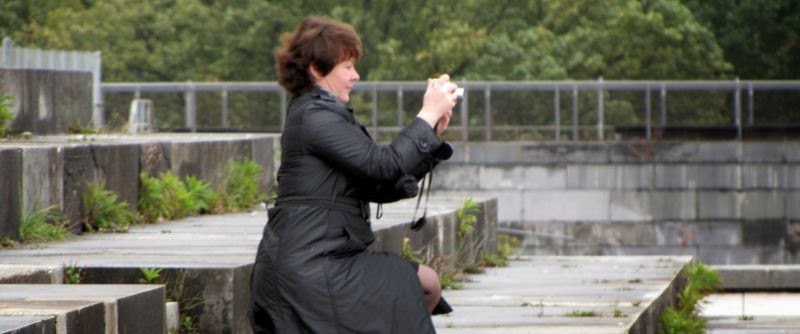
A photo-op of a loved one


Hitler stood here.

Spotlights, aimed skyward, created the stunning  "Cathedral of Light"

Destruction of the Enormous Swastika that faced the hordes of devotees.

Near them, on the sand,
Half sunk, a shattered visage lies, whose frown,
And wrinkled lip, and sneer of cold command,
Tell that its sculptor well those passions read
Which yet survive, stamped on these lifeless things,
The hand that mocked them and the heart that fed.

This power station fed the Cathedral of Light. It produced enough energy for a major city.

This Nazi Eagle once hovered over the station's doorway.

And on the pedestal these words appear --
"My name is Ozymandias, king of kings:
Look on my works, ye Mighty, and despair!"

(Just in case you missed it in the photo immediately above.)


Nothing beside remains. Round the decay
Of that colossal wreck, boundless and bare
The lone and level sands stretch far away.' 


"You want fries with that?"


Love,
Wilson,
and Robert

Wednesday, October 22, 2014

In Search of the Third Reich III

Dachau

MUNICH, OCT 21-- The Dachau concentration camp is barely a half-hour drive from this city. Wilson, Tracy and I drove there this week. It's sort of a prerequisite for being part of the human race. The following photos are provided with as little comment as possible. Comment is specious.

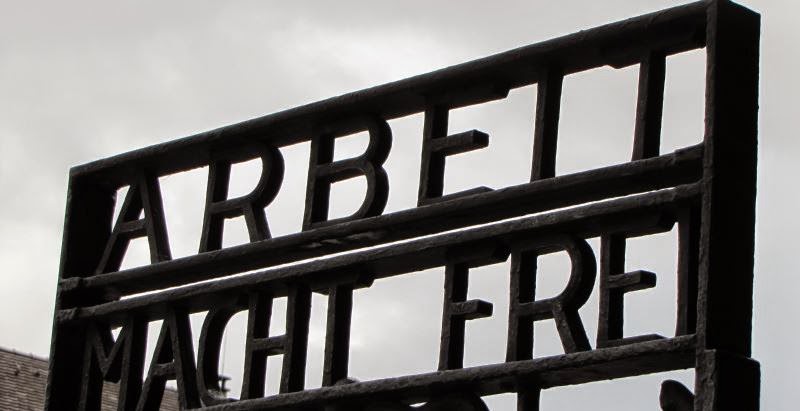
Prisoners entered through the archway.

"Arbeit Macht Frei" translates as "Work Will Make You Free."


Living quarters, right; foundations for torn-down living quarters, left.

Maintenance Building, left; prison, right.


Gas was fed into the "showers" through the open ports.

For fumigating clothing.


The "showerroom"

Peep hole for supervising the "shower"

An oven


Robert,
and Wilson