Friday, May 8, 2015

Wilson and other third world technologies

We have this story beating around in our heads that sophisticated technologies are going to make our lives better. However, "sophisticated" usually indicates difficult and complex. But what is happening for the third world is the introduction of technologies that are affordable and simple. The technologies include masonry that requires no mortar, inexpensive water filters, teeth flouriding tool kits, smokeless cook stoves, shoes that grow, and Wilson, my virtually indestructible soccer ball which makes standard balls almost obsolete.


Wilson checks out the strange cinder blocks. Like many of you readers, the indestructible has never seen blocks like these before.


On Thursday I introduced Wilson to the Haener construction block. something many of you readers may remember from a year ago when I blogged about building a home for a poor family in Tijuana. (For that story, allow me to direct you to   http://tjposada.blogspot.com/2014/05/the-mighty-haener.html.)

The company which markets this block calls it the "mortarless interlocking system."  Their Web site adds:
Stacked without Mortar, Haener Block can be laid up to 10 times faster than conventional block by skilled, semi-skilled or unskilled laborers. Self-aligning and uniform, Haener Block structures look professional and aesthetic the first time, every time!
Oh, I should mention that last year I misspelled Haener. Well, it's spelled right this year--I think.

It's unclear to me what the rights of duplicating this technology are. As it was explained to me Thursday, families create these blocks and then Esperanza uses them when it comes time for volunteers to build the new home.
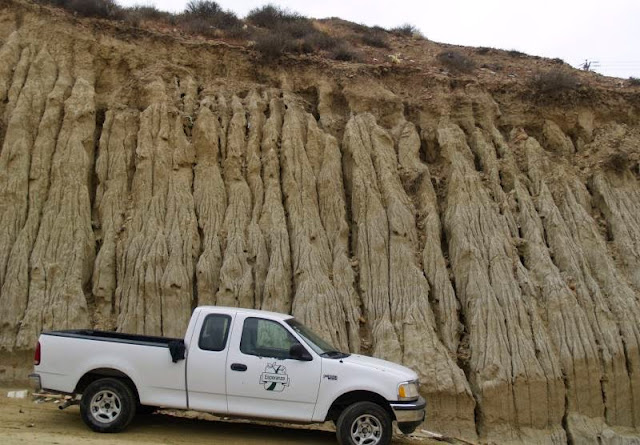
This bank gives an idea of the environment where we were making the blocks. You don't buy them at the store, you make them on site.


The blocks are made by shoveling sand and cement into this machine, which creates several types of  cinder blocks using molds. The white strip about mid-way up is a small pallet that supports the block. You shovel the mix in one side, the machine makes a whole lot of noise, and like magic, the block is ready to remove. Doesn't it kind of look like an old printing press?


A bird's eye view of the manufacturing site: sand pile to one side, cement bags, the mixer, and the cinder block machine. Start the presses!


Alex Cratsenberg grabs some pallets for the press.


Wilson watched some women folk drag sand into buckets that wait, like little birds, with their mouths agape.


A fish-eye view of the process. In the background someone feeds the mixer, while the press does it's magic. The shoveler isn't being lazy, just patient. The machine is full and the blocks are about to emerge.

By the way, I should mention that some of the people in these photos won't be identified. My traveling mouse has just stopped working and I have to move the pointer around using the &#*@!!?//(*)&$$ finger pad on this laptop. I hate those things. See what I mean about complicated technology? At least I have an excuse for typos in this dispatch.

Presto! Dos Haeneres (two Haeners). This provides a clear view of how the blocks interlock with blocks that are rested on top of them. Rebar lies in the grooves to further lock them together.


Moving the fresh blocks is a dicey process. If they are shocked or tapped they can fall apart. Susan Nadeau and a colleague wearing a hoodie and therefore known but to God, carefully walk across the work site and down an uneven dirt path over tires set into the ground to stabilize it. They deposited this pair of blocks in a spot with others, they will set up in a couple hours and then cure over the coming day.


Ooooops! See what I mean? One bump and the blocks can crumble at this stage. But then you just drop the broken pieces back into the press and try again.


Some of the sand had rocks in it, so one enterprising worker,Tonyia Cairns, scrounged out a piece of screen and they shoveled the sand into the bucket through the screen.


Occasionally the mixer needs to be cleared out.


Klaus Schweintek relies on his hammer to persuade caked-up mix to let go.


The work site: The wood frame structure that was demolished and then repositioned for the family's abode until a new structure is built; the doorway to the kitchen they will continue to use; and the newly-minted building blocks. We produced 158 of them in just a few hours. A home normally requires about 600.


I promised to tell you about some of the other technologies. Here's one of them -- the shoe that keeps on growing is pictured below. Now I'm not going to spoon feed you on this one -- Google "the shoe that grows" and find out how this simple technology is changing the lives of third world children.

Other simple and game-changing technologies I've come in contact with:
  • Break-open flouride kits that can be used on young mouths; you use the kit and discard it and it's good for about six months. I flourided a whole bunch of mouths four years ago using this technology in Peru. This story  and two others immediately below is told in my 2011 blog, incadiaries.blogspot.com.
  • Smokeless wood stoves that replace open hearths that women use the world over to cook indoors. The stoves are designed to carry all the smoke out of the home. Google the clean cook strove project. These stoves are easily repaired and use no expensive parts.
  • Ceramic water filters, which I helped make in Peru. They remove 99.9 percent of pathogens by simply allowing water to drain through a special ceramic pot made of clay, sawdust and water.
  • The One World Futbol -- a virtually indestructible ball that never needs replacing, and brings play to children all over the world in the world's most popular sport --soccer. You already know about that--that's what Wilson is all about.

The point of this is that there are simple ideas that are making strategic changes for the better in people's lives. These products demonstrate that there are solutions that don't require big expenditures, and which are sustainable. We are gaining increasing ability to deliver strategically useful and sustainable technology to ordinary people in the third world.

We can do this!

Since my mouse has died, it's going to be very difficult to deliver more commentary and photos until I'm home in a couple days. There's more to tell, and I hope you're interested. And thanks for coming along.

Love,

Robert, and
Wilson


Paola and Gustavo's youngest child stands at the kitchen doorway, aware that the home she knew is gone, and only mildly aware that the new, more dignified home she will grow up in will arise from those blocks beside her.


Wednesday, May 6, 2015

What the little girl saw


After starting out with demolition, the volunteers to Tijuana from St. John Vianney Parish in Kirkland, WA, changed gears and got into home construction on Wednesday. Their project benefited the residents of a mobile home in Rosarito, a suburb of Tijuana.

This vintage mobile home sits on a parcel of property where Esperanza, a Tijuana nonprofit is constructing a "dream home" for a low-income family.


In the doorway, Dafne, a toddler watches the arrival of the construction team.


Jan Kline, coordinator for the Seattle group, and Alex Cratsenberg, a long-term Esperanza volunteer and graduate of Seattle University, speak with Emma, the ama de casa (lady of the house).


The volunteers set to work continuing the process begun on Tuesday, when they dug foundation trenches.

Even through the ground being excavated lacks roots, it is full of clay and quite thick and stubborn. The digging was exhausting. The first day's work involved piling the dirt excavated for the footings in mounds contained with cinder blocks which will later be used for the footings and the walls of the home.


The dense excavated soil is contained in cinder blocks and surrounded by the foundation trenches.


Wilson found a perch from which he could observe the work. Having no arms or legs, he could only watch.

The trenches needed to be deeper. While Nick Petlow broke up the ground with a pick, Sandy Kubishta shoveled out the loose chunks.


Every now and then there was an archeological discovery -- such as this small toy horse. Someone jammed in a male figure to replace the lost head.


There were other strange sights. As Christine McLeod bowed her head in silent prayer, Sandy Kubishta apparently dredged up a poltergeist, which she flung aside. There was no clear indication of how long the demonic spirit had been lurking in the clay.


Working a project under these conditions calls for bucket brigades, which were organized to move soil, cinder blocks and sand, and which will eventually be used to move the gravel and sand which will be mixed to become cement. Then the cement will be hauled in the same fashion for the home's footings and walls.


A bucket brigade formed to move the earth. Tanya Cairns hefted a bucket of soil to Alisen Barrow.


Monica Dykas recycled an empty bucket back into the bucket brigade line.


Buckets move faster through the line if you reserve the right to toss them. Deana Barrow tosses one to Alex Cratsenberg.


These cinder blocks follow the so-called Hainer design. The blocks have raised areas that help them interlock with one another. Note the rebar that lies down the center. It is hammered into the grooves in the blocks to create a rigid connection. There are ties that hold the rebar sections together snugly. Cement is poured into the hollows of the blocks to create a wall that stands up well to earthquakes. It is a simple and effective technology.


Prior to placing the foundation blocks, the trenches were layered with sand, which Steve Zeller is tapping down.


Karen Maxwell cut wires to tie the rebar, and Paola, a youngster living at the house, helped fold them in preparation for their use.

Afterward, Paola helped Deana Barrow flatted out rebar which had been cut and bent.

The language barrier wasn't enough to keep these two from working together.

 Tomorrow, (Thursday), the volunteers have to three objectives -- build more Hainer blocks at the demolition site where this week's work began; return to this site to continue foundation work; and finally, prepare the "Posada," Esperanza's volunteer headquarters, for its 25th Anniversary fiesta. Wish you could be there!

Love,
Robert, and
Wilson


Tuesday, May 5, 2015

Demolition!

Sometimes we build homes. This time we destroyed one. Well, sorta.

The assignment was to demolish part of a home so that it could be made, uh, more better, as they say. It's an unusual task for Esperanza, the Tijuana organization that has built homes for hundreds of Tijuanans over the past 25 years, but the 25 visitors from St. John Vianney Parish in Kirkland, WA were up to the task Monday.

Esperanza staff, friends and neighbors attended the pre-demolition meeting with the property owners, Paola, in the red shirt, and her husband, Gustavo, on her left. At times, Gustavo was unable to conceal his deeply-felt gratitude for the help from the volunteers.


The demolition site was situated at the base of a sharp bank of sandy clay. Note the tires which were worked into the bank to make a staircase.


Wilson watched as a army of worker ants set about their work.


As others tore at the roof from above, Tom Nadeau hammered from below.


Stevel Ellis, right, peeled back shingles and pried up plywood. Klaus Schwientek, left, prepared to pitch the plywood to the ground below.

Ben Larson peeled off a two-by-four


An Espeanza truck conveyed the tools to the work site.


Klaus Schwientek, Greg Seiler and Stephanie Larson watched the demolition from above. Schwientek is a diesel mechanic and Seiler an architect.


Mike Kline and Shelly Cerio rip out a doorway under the watchful eye of Klaus Schwientek.


Esperanza staffer Sean MacCarthy removes roof trusses while Eduardo Zabala Reyes of Esperanza climbs up to join Greg Seiler, who is standing on the level where the old structure will be positioned.


Somehow, even when operating a power saw, Greg Seiler has managed to never bite his tongue.

Susan Nadeau doesn't let a little hard work keep her from wearing her fashionable earrings.


Lifting the first wall for the new structure onto the upper level.


Lining up the first wall for the renewed building.


Alisen Barrow and her mom, Deana, fuss over a bemused Karen Maxwell, who received a nail puncture in her calf.


The resurrection: The old wooden structure takes on a new shape and a new elevation.


Tom Nadeau and Steve Zeller line up for lunch while Karen Maxwell, recovering from her leg wound, triumphantly squeezes past with a plateful of food. General agreement was that the frijoles were the best they had eaten -- anywhere!


Chris Larson lines up for a meal served up by Paola in a very small and crowded kitchen staffed by friends.


Stephanie Pratt tries her hand with a sledge hamnmer while Steve Ellis gets out of the way.


Steve Ellis persuades the concrete to let go of the rebar.


Nick Petlow operates a jack hammer while Steve knocks down more wall.


Demolition is virtually complete. Now time for cleanup, and then preparation for a replacement structure.


The work site at end of day The doorway at the far wall leads to the kitchen where the volunteers were fed. Atop that part of the building is the reconstructed house, which will gain a new roof on Wednesday. And by mid-summer, a new concrete-block home is anticipated.


The obligatory end-of-day group shot.

Paola hugs Jan Kline, coordinator for the volunteers.

I should add that this dispatch was posted in haste. Any typos are the property of the author.

Love,
Robert, and
Wilson


Sceiler and  Schwientek squaring the corner for the reconstructed wooden building. (This really great photo was taken by Jan Kline. --ed.)